


(1913 - 1957)
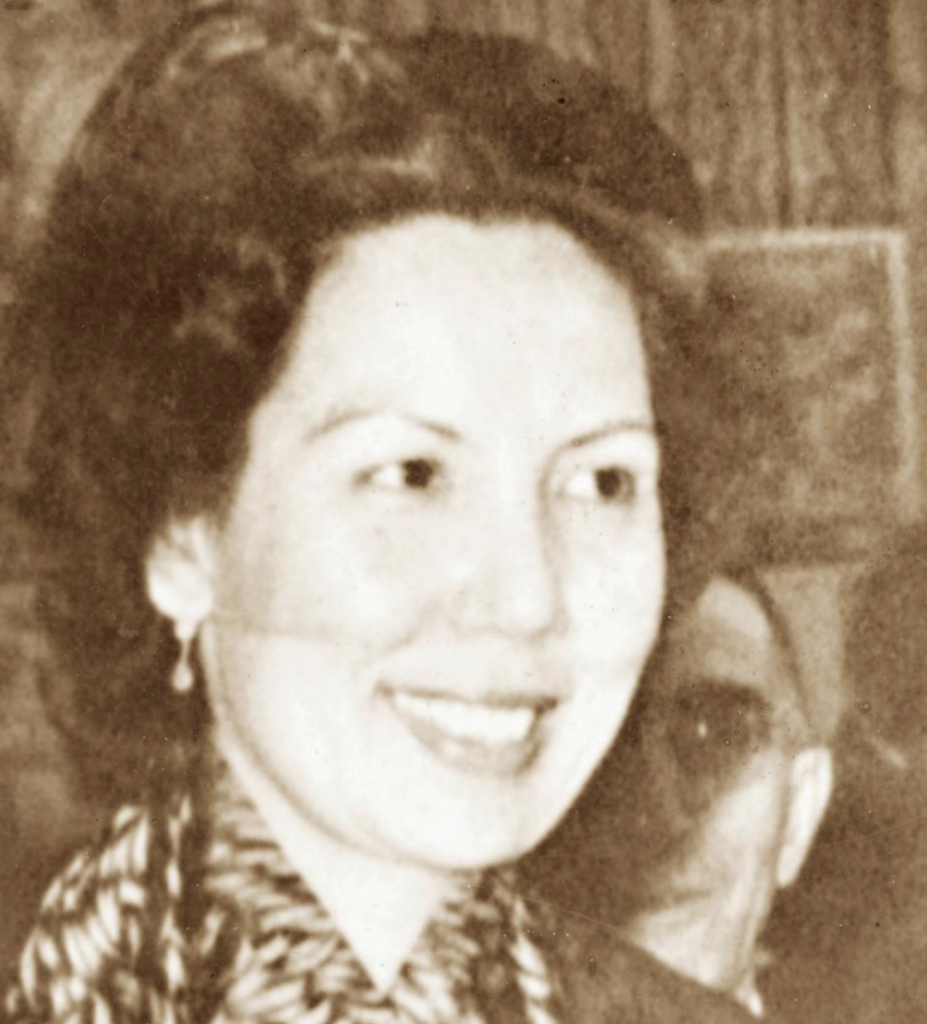
Born in Macau on 7 July 1913, to a Portuguese father and a Macanese mother, Deolinda da Conceição was a pioneer in matters of women’s emancipation, both in theory and in practice. This commitment was evident in the way she shaped her life and secured her livelihood through her dedicated work in education, journalism, and translation. In 1931, after marrying Luís Gaspar Alves, she settled in Shanghai, where she had two children.
However, in 1937, while separating from her husband, she took refuge with her children in Hong Kong due to the Japanese invasion of Shanghai. In Hong Kong, she lived for a time in a refugee camp, ran a school, and worked as a translator.
After the end of the Second World War, she returned to Macau and worked as a journalist and teacher. In 1948, she married António Maria da Conceição, with whom she had another son, António da Conceição Júnior.
In 1956, Deolinda da Conceição visited Portugal for the first time, where her only book was published: A Cabaia [Cheong Sam] (A cheong sam is a dress traditionally worn by women in China), a work praised by João Gaspar Simões, one of the most renowned literary critics of the time. In this context, as Seabra Pereira notes, Cheong Sam constituted a turning point in Macanese literature, “as it marked the beginning of a new era in the literature from Macau – and in more than one way: not only in terms of the institutional functioning of literary life, in which a woman asserted herself as a writer and, as an author, not a dilettante, engaged in the artistic communication system, and contributed to it as an aesthetic-literary message” (p. 183).
Across its twenty-seven short stories, Cheong Sam portrays Macanese society at the time and the efforts of female characters, many in exile, to achieve emancipation. The work also recounts the lives of Chinese women and men who either succumbed to or resisted oppression, extreme poverty, and age-old superstitions. It further reflects on the dangers of materialism and the numerous prejudices suffered by Chinese women. Moreover, the effects of the Second World War are evident, experiences the author herself endured. During the Sino-Japanese War (1937–45), she was forced to flee from Shanghai to Hong Kong, and had to bear the hardships of exile, which she would later channel into various characters in her stories.
One of the emblematic short stories dealing with the theme of women’s struggle for emancipation and the aftermath of war is precisely the one that gives the collection its title: Cheong Sam. In it, we are introduced from the outset to a man who, as revealed in the opening lines, has been sentenced to lifelong exile. He appears half-mad, perhaps with guilt, and is constantly haunted by the vision of the cheong sam, or cabaia, worn by his wife, whom he murdered. As Monica Simas notes, “The cheong sam of the dead woman is an icon of a discourse that enables the memory of annihilation; it reflects the absence of voice, silenced by violence, yet echoing in dreams, inhabiting the borderline inscription of reality, questioning the reasons behind her fatal destiny” (p. 32).
The responsibility for all this misfortune is attributed to the war, that is, to a cause external to the protagonist: “Damn war! Damn war, which had taken everything from him and turned him into a criminal, a murderer, a heartless father, a man without reasoning” (Conceição 2007: 19). In other words, the war is portrayed as the alienating and dehumanising force that triggered the entire tragedy, the contours of which begin to unfold in the passage below, through an analepsis. It is only then that the protagonist’s name, A-Chung, is revealed, along with the fact that his engagement had been arranged between the two families involved. His fiancée, Chan Nui, insisted on leaving to study for two years before their wedding, since: “She had learned the language of the New World and admired, through the cinema, everything she saw of that country, which seemed to appeal to her with its different way of life, its customs and traditions, and the restlessness she felt in her own blood” (Conceição, 2007: 21). This attitude reveals Chan Nui’s courage, ambition, and determination, traits that contrast sharply with the submissive role typically expected of women in this social context. At the same time, there is an implicit drive to discover the “other”, that which is different and unfamiliar in the “New World”, which, in this case, is associated with the United States. Interestingly, this perspective also reveals an ethnocentric view that reduces the “New World” to a single Western country, perceived as both mysterious and unknown.
The narrative then focuses on Chan-Nui’s return, now matured and completely transformed by her experience abroad. “The young woman who had left timid and hesitant returned as a perfect woman, elegant, speaking fluently and with firm gestures, self-assured and aware of her refined education” (Conceição 2007: 21). As a result, A-Chung immediately realises that his fiancée is entirely different from the women of his own society, as “She was assertive, spoke to him as an equal, without servility, independent, making immediate decisions about how to conduct herself and how to maintain her place in the society of strangers” (Conceição 2007: 21). Immersed in a distant reality and a culture different from her own, Chan-Nui had transformed and become emancipated. Throughout the narrative, we witness her struggle to preserve that emancipation within an environment that is clearly oppressive and stifling when it comes to female independence and self-determination.
Thus, Chan Nui evolved through her contact with foreign culture, returning as an independent and emancipated woman, an identity that did not fit within the patriarchal and conservative Chinese society.
In fact, despite everything, Chan-Nui strives to readjust to the rules of society, although she reveals respect and carries out the imposed rituals with confidence and dignity.
Indeed, we see that later, when the family suffers the consequences of the Sino-Japanese War, the husband is unable to find work, and hunger descends upon the household, threatening the survival of both him and the children. At this moment of deep crisis and misery, Chan-Nui encourages her husband to find a job to support the family, but he fails to succeed. Faced with the threat of seeing her children starve, she rebels and begins working in the city’s dance halls to provide for the family. However, besides feeling deep jealousy, the husband’s pride and dignity are wounded, and at the core of his humiliation, he begins to harbour a desire for revenge: “At this point, we observe the psychological conflict tearing the character apart, divided between jealousy, resentment, wounded pride, anger at depending on his wife, and the need for survival.” Thus, the husband’s mediocrity and incapacity stand in stark contrast to the vitality and initiative of his wife.
Nevertheless, the breaking point and tragedy are triggered by Chan-Nui becoming dazzled by wealth. One day, she travels to another city to accompany a wealthy foreign client. Drawn to the luxury of this new life, she loses track of time and forgets both family and responsibilities, becoming aware of them again only when she reads in the newspaper her husband’s plea for her return, as one of their children has fallen ill. Upon returning home, in a fit of jealousy, A-Chung murders her. As David Brookshaw suggests, this is a story of a clash of values and female emancipation within a traditional society whose structure had become unstable due to war and the need for displacement (Brookshaw, 2002: 72). In this story, alongside the already mentioned theme of female emancipation, it is essential to highlight the transformations brought about by a Western education, which can sometimes encourage an appreciation for certain types of luxury. Notably, there is a clear preference for the female character, whose intelligence, and independence differ markedly from the mediocrity and, in a way, the incapacity of her husband to succeed in life, ultimately revealing his most primal and violent instincts. In this context, as Monica Simas notes, “‘Cheong-sam’ is the cabaia that inscribes the space of representation in a persistent questioning; it is an indicator of transculturation; it is also a mark of the feminine, representing the boundary of the home and functioning as a metaphor for desire” (p. 30).
We observe that, generally, the female characters take on the role of protagonists in Deolinda da Conceição’s stories, embodying the author’s concerns. At times, the author projects herself onto a variety of characters who may range from femme fatales to submissive or even emancipated and altruistic women, though, overall, they tend to be dutiful and respectful of traditions. Furthermore, there is a strong belief in the education of women as a crucial catalyst for the difficult process of emancipation. The theme of exile also emerges, affecting some female characters directly or indirectly through the departure of loved ones.
In short, Deolinda da Conceição not only represents a landmark shift in literature by being the first author to break Macau’s boundaries and gain recognition in Portugal but also pioneers a multimodal approach in her portrayal of female characters. These characters fluctuate between a struggle for emancipation (often silenced by the social conventions prevalent in the 1940s and 1950s) and submission and obedience to tradition.
Quotations
For two years, Chan Nui’s letters and photographs revealed the transformation taking place in her, but the elders only noticed her growing beauty and the wonderful things she told them about that distant country. The young woman who had left timid and hesitant returned a grown woman, elegant, speaking confidently and with firm gestures (…) aware of her refined education.
A-Chung saw her and understood that Chan Nui would never be like the women around him. She was determined, spoke to him as an equal, without servility, independent, making immediate decisions about how to conduct herself and how to maintain her place in the society of strangers. Months later, the wedding took place (…).
Beautiful and elegant, she performed with ease the rituals imposed on brides in China, such as kneeling before her in-laws to offer the traditional cup of tea, bowing in reverence to the eldest members of both families, and so on. (Conceição 2007: 21)
She shouted to him her revolt and contempt, the full disappointment of her life at being chained to a man like him, devoid even of paternal feelings, and vowed that she would face fate, war, hell, and death itself so that her children would no longer suffer from hunger. (Conceição 2007: 24)
And one day, when he felt the urge to embrace her, that cheong sam that so many knew and cherished appeared before him. He felt the desire to tear it apart, but the rice it carried was vital for the children. (Conceição, Cheong Sam, A Cabaia 2007: 25)
Selected Active Bibliography
Conceição, Deolinda da (2007). Sam-Cheong, A Cabaia, 5ªed. Macau, Instituto Internacional de Macau.
Selected Critical Bibliographya
Brookshaw, David, “Deolinda da Conceição, a pioneer”.In http://luso-brazilianstudies.blogspot.com/2010/10/pioneer-of-womens-writing-in-macau.html
Gago, Dora Nunes (2017). “Figurações femininas nas obras de Deolinda da Conceição, Maria Ondina Braga e Fernanda Dias: os árduos caminhos do exílio e da emancipação”. Revista de Cultura de Macau, 6-17.
Pereira, José Carlos Seabra (2013), O Delta Literário de Macau, Macau, IPM.
Sena, Teresa (2010), Conceição, “Deolinda Salvado da”. DITEMA, Dicionário Temático de Macau, Volume I, Universidade de Macau, p. 394
Simas, Monica. 2016. “Podem Os Macaenses Falar? Da Subalterna à condição Especial”. Cadernos De Literatura Comparada, n. 29 (Julho). https://ilc-cadernos.com/index.php/cadernos/article/view/162.
Autor(a): Dora Nunes Gago | Ciência Vitae | | |
Tradução: Marta Correia